
Do you remember as a child or teenager sitting with your friends, palms up, tracing the lines in your hand in order to divine your future?
“This is your life line,” I remember a young girl telling me. “It tells you how long you will live.” Each of us studied our own line, wondering what increments to use to determine the decades. Soon we were comparing lines to see who was going to live the longest.
Because when you are young, you wonder a lot about your future.
That was fifty years ago, and it’s been a long time since I’ve studied my palm. Now, I study my face. I wake in the morning and stare at the aging man staring back at me in the mirror. More and more he looks like my father, which doesn’t bring comfort. Depending on how I slept, one side of my hair is flat. The rest of my head looks like I’ve put my finger in an electrical socket. All that’s missing are wisps of smoke spilling out of my ears.
As I lean closer, I see lines. Some turn into cracks. These tell the story of my past. A life of squinting outdoors in the harsh Texas sun. A life of laughter revealed around the eyes. And a life of worry etched into my forehead. The cracks don’t reveal details, which I’m grateful for. Because I know that the smaller cracks in my face lead to the larger cracks in my life, which I would rather remain hidden.
I’m uncomfortable with these cracks. I smear cream on them every morning to try to make them go away, but despite the promise on the package, the cracks remain, reminding me of the inevitability of aging.
Last spring, I took a group of students to Ireland on a pilgrimage. Our last stop was Glendalough, where a spritely octogenarian priest outpaced us on a journey around the lakes. He loved to tell stories, but not just to entertain. These were prophetic utterances, decoding the mysteries of this sacred space.
At one point he stopped, almost as an afterthought, and he pointed to a perpendicular, rocky side of the hill near the path.
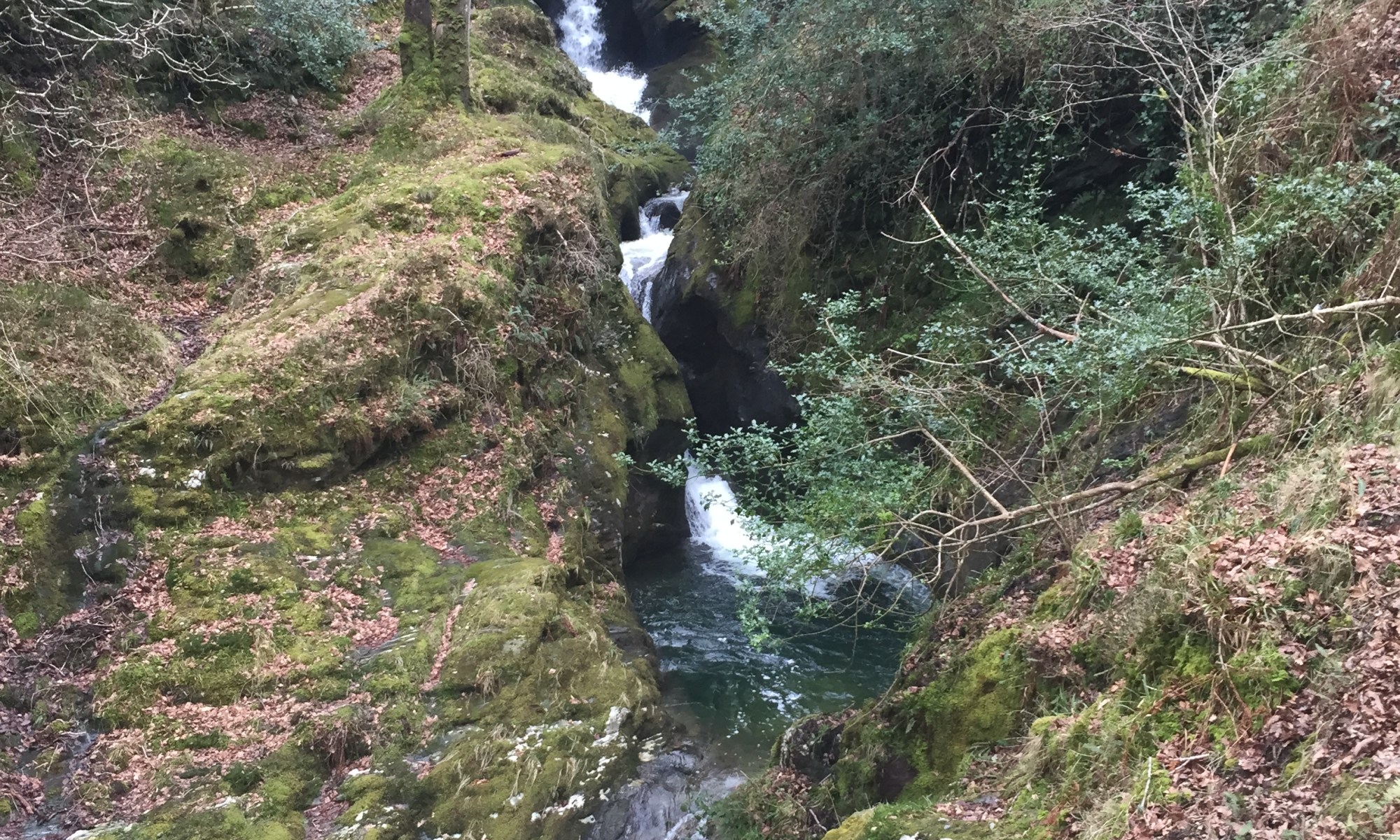
“Look at the cracks,” he said in his gentle Irish accent. “See how the water naturally collects in them and trickles into larger crevices.” He waved his walking stick and our eyes followed.
“The water erodes the cracks even further over time, allowing more water to collect.” He moved closer and pointed to a place where the water fell like a gossamer ribbon into a dark pool at the base.
He continued, “Eventually the cracks get deep enough so that it can carry even more water, until…,” he pointed down the path to a rush of water splashing over boulders. “You get a waterfall.”
As we approached the air cooled and the roar got louder. I imagined a thousand fairies living nearby.
“Our lives are filled with cracks,” he said. “And we think of them as bad. But from the cracks one gets waterfalls. Glorious, beautiful waterfalls.”
He smiled, allowing the truth to settle in. “And everyone loves a waterfall. But you can’t have a waterfall without the cracks.”
We lingered for a while admiring this place of wonder, full of wild, uninhibited life.
I’ll never look at my face the same.
 Spilled Coffee on Ancient Scrolls
How neat .
LikeLike